Project frame
- Role
- Designer and developer
- Collaboration
- Independent project
- Contribution
- Experience architecture, authored world geometry, accessible interaction, and validation systems.
- Outcome
- One portfolio that supports spatial exploration and complete conventional routes without changing its content or topology.
- Spatial world
- Traveler and archive
- Shared content
- Direct routes
- Semantic pages
- Shared content
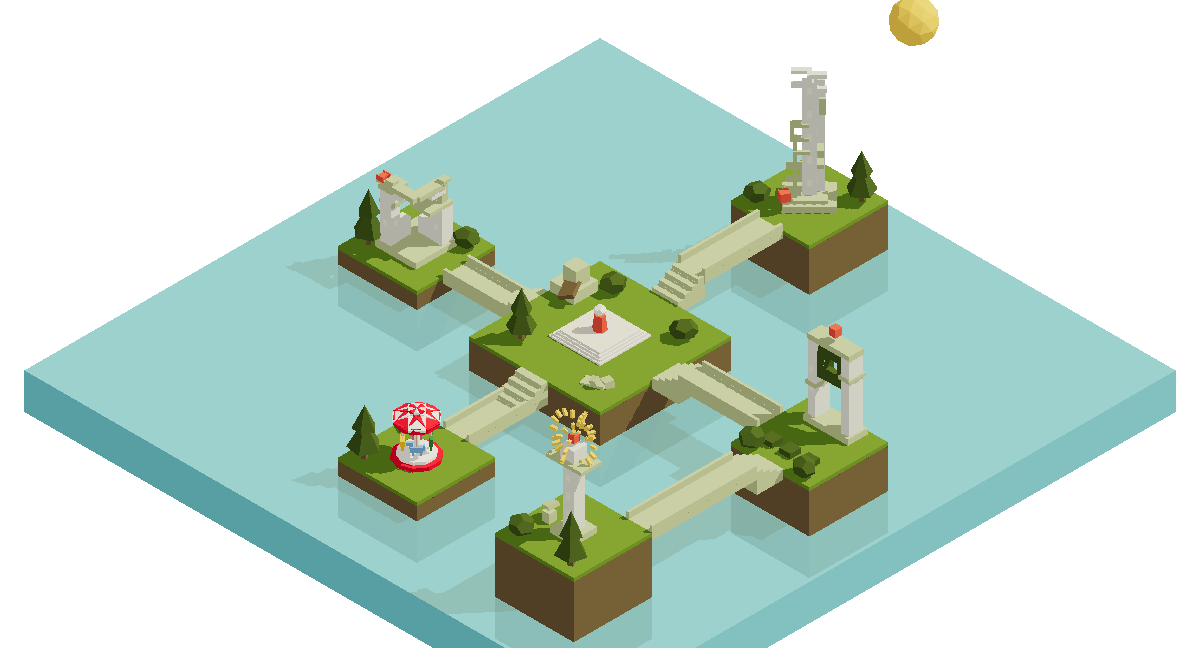
Living Archive is the portfolio you are using now. Instead of arranging work as a résumé grid, it presents one connected low-poly habitat that can be orbited, explored, and read as a personal place.
A portfolio with two ways through
Visitors can select an island and watch a small geometric traveler find its route across the world. The same employment, writing, projects, interests, and about content remains available through semantic HTML, static pages, and a conventional index.
That second path is part of the design rather than a fallback added at the end. The essential content does not depend on WebGL, animation, pointer input, or JavaScript.
Authored structure
The world is assembled from deliberate low-poly primitives on a fixed grid. Rotation changes the view, never the topology. Travel runs deterministic A* pathfinding over one validated graph, and a visitor can choose a new destination while the traveler is already moving.
Accessible DOM labels are projected from authored 3D anchors so they remain upright, focusable, and clickable as the scene rotates. Reduced-motion, data-saving, keyboard-only, and no-WebGL paths are treated as complete experiences.
Building a dependable illusion
The project uses Astro, React, React Three Fiber, Three.js, TypeScript, MDX, and vanilla CSS. Geometry validation, unit tests, accessibility checks, visual regression coverage, and scene-budget checks keep the playful surface tied to predictable behavior.
The work is ongoing. Follow the implementation in the Living Archive repository.
Continue toColorCam